
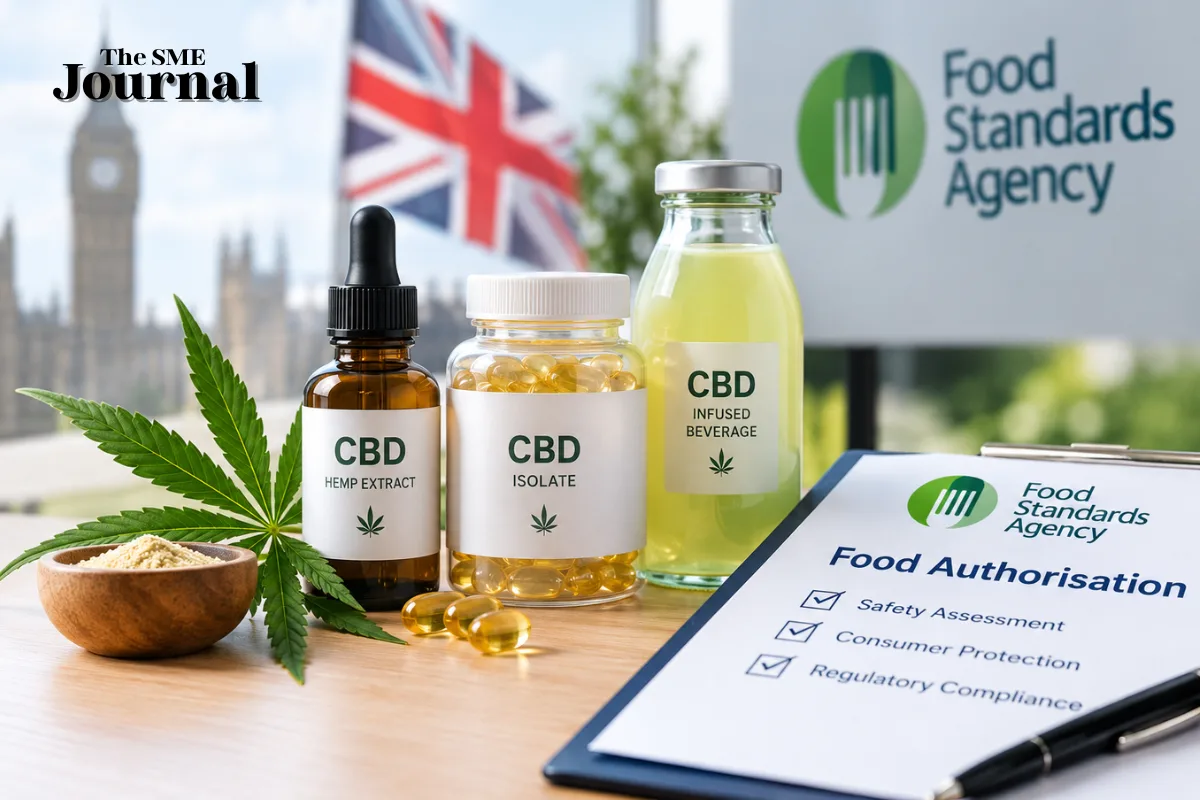
The UK is moving closer to approving its first CBD food products, following new recommendations from the Food Standards Agency (FSA). The agency has backed three applications for high-purity cannabidiol products, potentially opening the door to a more clearly regulated market for CBD food supplements.
The recommendations, updated on September 15, 2026, cover two CBD isolate products and one synthetic CBD product. While the announcement represents progress for manufacturers and retailers, final authorisation will depend on decisions by government ministers.
For an industry that has spent years navigating novel food requirements, the latest development could bring greater clarity to product approvals, safety standards and compliance responsibilities.
Three CBD Products Move Forward in the Approval Process
The three applications under consideration are RP 7, RP 350 and RP 427. They include one synthetic CBD product and two CBD isolate products, each containing at least 98% pure cannabidiol.
The agency has also reviewed feedback from a public consultation before preparing its recommendations. The consultation received 46 responses from consumers, businesses, industry groups and local authorities.
The development is important because CBD products have remained subject to novel food regulations in the UK. Although many products have continued to appear on the market, businesses have had to navigate an approval process that has taken several years.
What the New Recommendations Mean for CBD Businesses
For CBD manufacturers and retailers, the proposed authorisations could provide greater clarity about which products may legally be sold as food supplements.
The FSA has recommended authorising all three products for use in food supplements. One application, RP 350, has also been recommended for additional uses in beverages and confectionery.
If ministers approve the recommendations, the authorisations would apply only to the specific products and conditions covered by the decisions. This means businesses cannot automatically assume that every CBD oil, edible or beverage would qualify.
The FSA says approximately 3,000 individual CBD products are linked to these three applications on its Public List. This makes the recommendations particularly relevant to companies already working towards regulatory compliance.
For smaller CBD businesses, clearer rules could also help reduce uncertainty around product development, labelling and market access.
Consumer Safety Remains at the Centre
The FSA has recommended a maximum acceptable daily intake of 10 mg of CBD for healthy adults. The proposed authorisations also include specific safety conditions and warnings for groups advised to avoid CBD consumption.
These include:
- People under the age of 18.
- Pregnant or breastfeeding women.
- People trying to conceive.
- Individuals taking medication.
- immunosuppressed People.
The recommendations also set limits on delta-9-tetrahydrocannabinol (THC) and other controlled cannabinoids, alongside clearer product labelling requirements to help consumers understand potential risks.
Why the Approval Process Matters
CBD has become a familiar ingredient in products ranging from oils and capsules to drinks and confectionery. However, its popularity has developed alongside questions about long-term safety, product quality and the legal status of CBD-containing foods.
Under UK novel food rules, CBD must receive the necessary authorisation before it can legally be placed on the market as food.
The FSA established a Public List to help manage existing products while applications progressed through the assessment process. The agency advises local authorities to prioritise enforcement activity towards CBD products that are not included on the list.
Importantly, inclusion on the Public List does not itself mean a product has received full authorisation.
The proposed approvals could therefore represent a meaningful step towards a more structured CBD food market, although businesses will still need to meet the specific requirements attached to any final authorisation.
A Wider Regulatory Challenge Beyond the UK
Another issue attracting attention is the difference between the UK's approach and the European Union's assessment of CBD safety.
The European Food Safety Authority (EFSA) has not yet published positive safety assessments for CBD novel foods. In February 2026, it announced a provisional safe intake level of approximately 2 mg per day for certain highly purified CBD food supplements, considerably lower than the UK's proposed 10 mg daily limit.
The two assessments are based on different datasets and approaches, and the figures should not be treated as directly interchangeable.
Meanwhile, discussions surrounding a potential UK-EU sanitary and phytosanitary agreement could also influence future novel food regulations. Depending on the final arrangements, businesses may face changes to the approval framework.
The SME Journal will continue to follow the latest developments in casino regulation, online gambling and the global gaming business.
Frequently Asked Questions (FAQs)
1. Has the UK approved its first CBD food products?
Not yet. The FSA has recommended three applications for authorisation, but ministers must make the final decision.
2. Which CBD products are being considered?
The applications are RP 7 (synthetic CBD), RP 350 (CBD isolate) and RP 427 (CBD isolate).
3. What is the proposed daily CBD limit?
The FSA recommends a maximum acceptable daily intake of 10 mg for healthy adults.
4. Can all CBD products be legally sold in the UK after approval?
No. Authorisation would apply only to the specific products covered by the decisions and their approved conditions.
5. Who should avoid consuming CBD products?
The FSA advises people under 18, pregnant or breastfeeding women, those trying to conceive, people taking medication and immunosuppressed individuals not to consume CBD.









.webp)