
What if the next generation of AI data centers isn't built on Earth at all?
That is the question Starcloud is trying to answer.
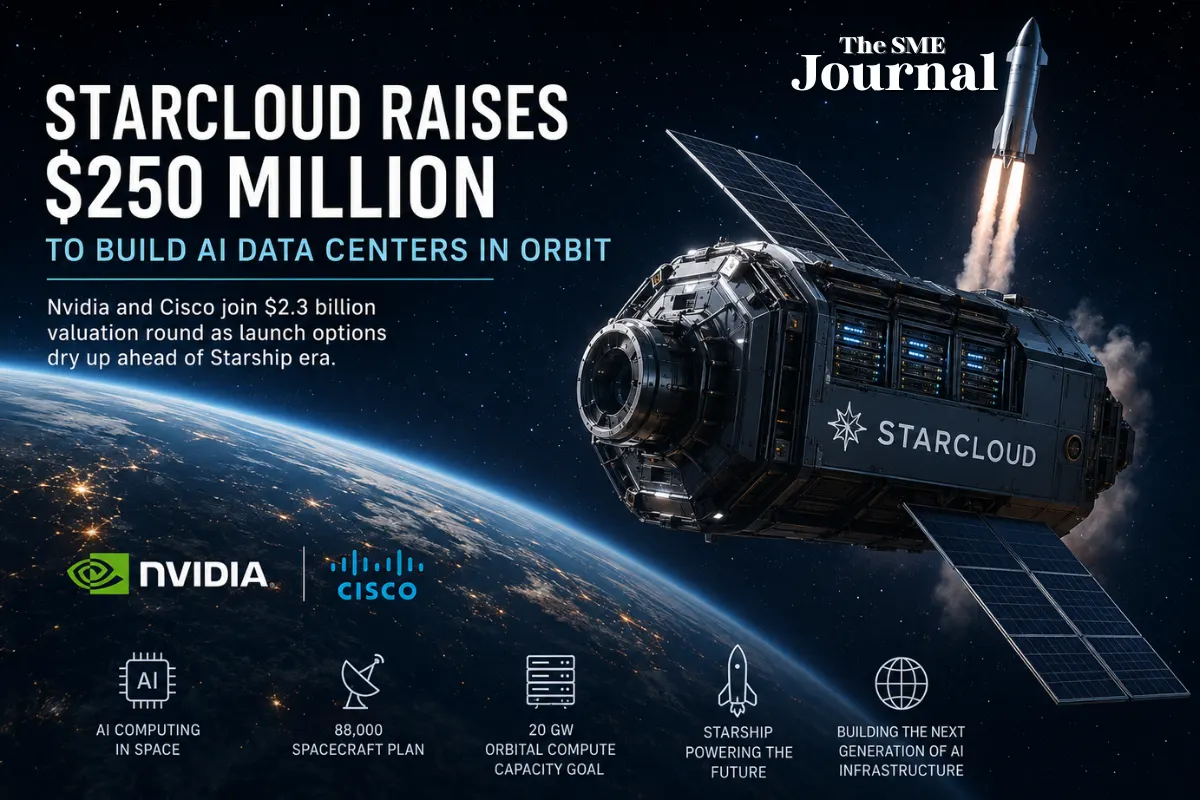
The space-computing startup has raised $250 million in a Series A extension, giving the company a $2.3 billion post-money valuation. Manhattan West led the round, while Nvidia and Cisco Investments joined existing investors including Benchmark, EQT, and Soma.
With the latest investment, Starcloud has now raised around $450 million since launching in 2024.
For a company that is still relatively young, the numbers are impressive. But the bigger story is what Starcloud plans to do with the money: build data centers in orbit and turn space into a new home for AI computing.
Why Put AI Data Centers in Space?
AI is hungry for computing power.
As companies build increasingly sophisticated AI models, they need more GPUs, more electricity and more physical infrastructure to keep everything running. Traditional data centers require huge amounts of land, energy and cooling, creating new challenges as demand continues to rise.
Starcloud believes space could offer another option.
Orbital data centers could potentially use abundant solar energy and operate away from some of the physical limitations faced by facilities on Earth. Instead of bringing all of the computing infrastructure to the ground, the company wants to take the infrastructure to orbit.
It sounds futuristic—and it is. But Starcloud is no longer treating the idea as purely theoretical.
Starcloud Has Already Put AI Hardware in Orbit
The company's biggest advantage may be the experience it has already gained.
In November 2025, Starcloud sent an Nvidia H100 GPU into orbit aboard its Starcloud-1 satellite. The mission was designed to demonstrate that a powerful, commercially available AI accelerator could actually operate in space.
Since then, Starcloud says it has pushed the experiment further.
The company has trained an AI model in orbit, run a version of Google's Gemini in space and demonstrated AI inference using hardware operating in flight.
Those achievements have helped turn Starcloud from an unusual space startup into a company attracting serious attention from the technology industry.
And Nvidia's participation in the latest funding round is a major signal.
Nvidia Is Betting on Space-Based Computing
Nvidia is already at the center of the global AI hardware boom. Its involvement with Starcloud suggests that the company is also interested in what computing could look like beyond traditional data centers.
Starcloud and Nvidia are working together on the Space-1 Vera Rubin Module, a space-ready version of Nvidia's Vera Rubin platform designed to handle the extreme conditions encountered in orbit.
Starcloud's satellites are expected to serve as an early platform for the technology.
For Starcloud, the partnership provides access to one of the world's most important AI hardware companies. For Nvidia, it offers an opportunity to gather real-world data on how next-generation computing systems perform in space.
But There Is a Big Problem: Rockets
Building a data center on Earth is difficult.
Building one in orbit is another level entirely.
Every satellite, GPU and piece of equipment has to get there somehow—and launch capacity could become one of Starcloud's biggest challenges.
The company is preparing for a major shift in the launch industry. SpaceX's Falcon 9 program is expected to wind down around 2028 as the company moves toward Starship.
Starship promises significantly greater payload capacity, which could eventually be a huge advantage for companies like Starcloud. But it has not yet become the kind of routine commercial launch vehicle that Starcloud would need for a massive orbital infrastructure buildout.
Other rockets are also at different stages of development. Blue Origin's New Glenn and ULA's Vulcan are not currently operating at the scale Starcloud would ultimately require, while Rocket Lab's Neutron has yet to enter regular service.
That leaves Starcloud racing to secure future launch opportunities.
As CEO Philip Johnston has put it, the company expects it will need to book an “enormous amount of launch.”
An Ambition Measured in Thousands of Satellites
Starcloud isn't thinking small.
The company has sought permission from the Federal Communications Commission to operate up to 88,000 spacecraft. Its long-term vision calls for roughly 20 gigawatts of computing capacity in orbit.
Those numbers show just how different Starcloud's ultimate goal is from a typical satellite startup.
The company isn't simply trying to launch a handful of experimental spacecraft. It wants to create an entire orbital computing infrastructure.
To make that possible, Starcloud is also investing in manufacturing on Earth.
The company is developing a 100,000-square-foot facility in Woodinville, Washington, where it plans to manufacture its next-generation Starcloud-3 spacecraft.
The spacecraft is expected to eventually launch on Starship.
The Starship Question
This is where Starcloud's opportunity becomes a little more complicated.
Starship could be exactly what the company needs. Its enormous payload capacity could dramatically change the economics of putting large amounts of computing infrastructure into orbit.
But Starship also represents an important dependency.
If the rocket becomes reliable, commercially available and capable of delivering the launch economics SpaceX is targeting, Starcloud could have the transportation infrastructure needed to scale rapidly.
If development takes longer than expected, launch schedules slip or costs remain high, Starcloud's plans could face significant delays.
In other words, part of Starcloud's future depends on something it does not control.
A Bold Vision With Real Risks
There is no question that Starcloud is chasing a fascinating idea.
The company has already moved beyond the “what if?” stage by demonstrating AI hardware in orbit. Its latest funding gives it considerably more resources to test whether those early experiments can become a commercially viable business.
But there is still a huge distance between operating one GPU in space and running thousands of orbital data centers.
Starcloud will need to solve problems involving launch costs, satellite manufacturing, energy management, cooling, communications, maintenance, regulation and the reliability of hardware operating far from Earth.
And it will need to solve those problems at a scale that has never been attempted before.
That makes Starcloud's $250 million funding round more than another big investment in an AI startup.
It is a bet on a very different future for computing.
If the company's vision works, the data center of tomorrow may not always sit beside a highway, near a power plant or inside an industrial park.
It could be hundreds of miles above our heads, quietly processing the next generation of artificial intelligence.
For now, Starcloud is betting that future is worth building.
Frequently Asked Questions
1. What does Starcloud do?
Starcloud is developing orbital data centers designed to run AI computing workloads in space.
2. How much funding has Starcloud secured?
The company has raised $250 million in its latest round, bringing total funding to about $450 million.
3. How much is Starcloud worth?
Starcloud's latest funding round gives the company a $2.3 billion post-money valuation.
4. What role does Nvidia play in Starcloud's growth?
Nvidia has invested in Starcloud after the startup successfully tested its H100 GPU in orbit and demonstrated AI computing capabilities in space.
5. Why is Starship important to Starcloud?
Starship's large payload capacity could help Starcloud deploy the large number of spacecraft needed to build its orbital computing network.
6. What is Starcloud's long-term space strategy?
Starcloud has requested approval for up to 88,000 spacecraft and aims to eventually deliver around 20 gigawatts of computing capacity in orbit.
7. Is orbital AI computing commercially viable?
The technology has been demonstrated, but large-scale deployment still faces major challenges involving launch costs, regulations, reliability and infrastructure.









.webp)