
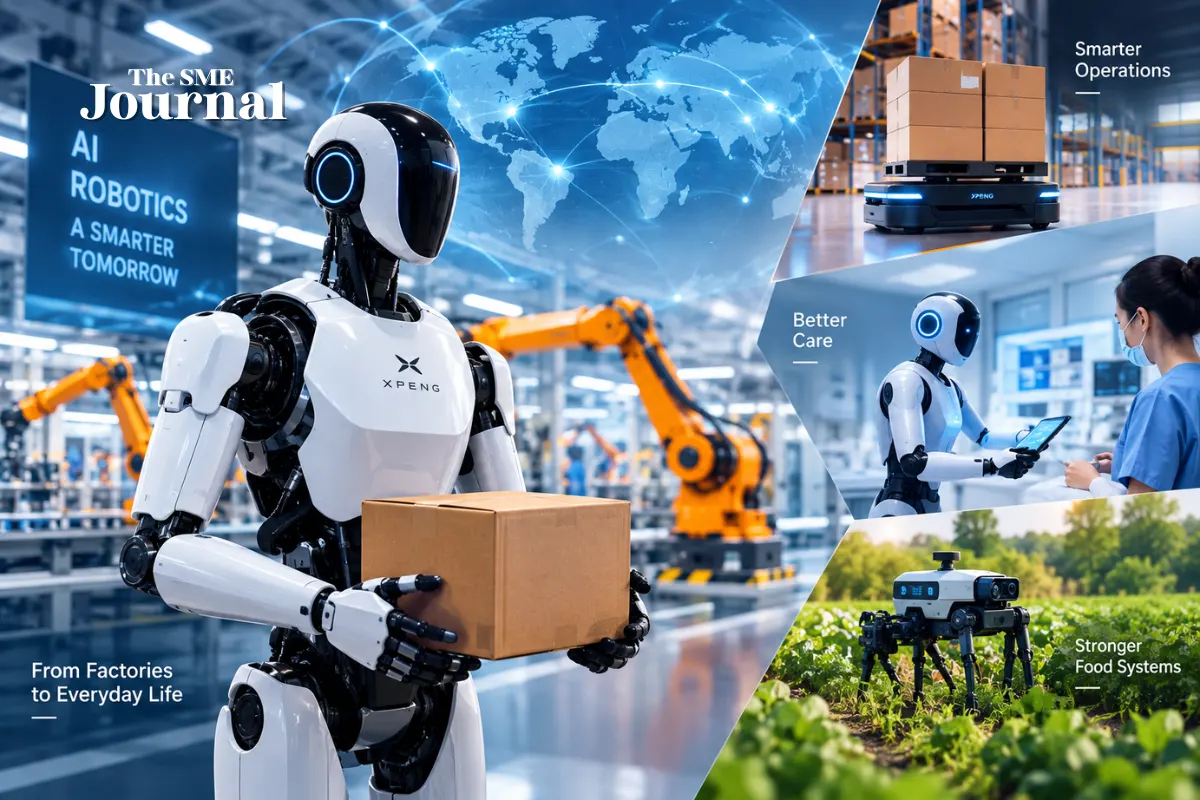
Robots are no longer confined to science-fiction movies or carefully controlled laboratory demonstrations. They are increasingly appearing in factories, warehouses, research facilities and even public spaces.
But the biggest story in robotics right now isn't simply that robots can walk, run or dance. It is that companies are beginning to figure out how to make machines useful in the real world.
One of the latest examples comes from Chinese electric-vehicle maker XPeng, which has completed assembly of its first Iron humanoid robot at its Guangzhou factory. The company is targeting mass production by the end of 2026, with deliveries expected in 2027.
That puts XPeng among a growing group of companies betting that humanoid robots could eventually become part of everyday life.
XPeng Wants Its Humanoid Robot to Leave the Showroom
XPeng's Iron robot is being developed as a general-purpose humanoid rather than a machine designed for just one industrial task.
The company plans to test the robot in its stores and campuses before moving toward broader commercial applications. The machine is powered by three internally developed Turing AI chips, providing a combined computing capability of about 2,250 tera-operations per second.
The ambition is significant.
Instead of building one robot for a factory line and another for a warehouse, companies are increasingly exploring whether a single adaptable machine could learn different tasks.
That is where artificial intelligence becomes important.
A robot that can physically move is useful. A robot that can understand its surroundings, remember what happened and adjust its actions could be much more valuable.
The Real Breakthrough May Be the Robot's "Brain"
For years, robotics companies focused heavily on hardware: better motors, stronger joints, improved batteries and more precise sensors.
Those things still matter. But the industry's attention is increasingly shifting toward what some researchers call the robot's "brain."
Humanoid robots need to interpret their surroundings and respond when something doesn't go according to plan.
Imagine asking a robot to pick up a box.
In a controlled demonstration, the box is exactly where it is expected to be. In a real warehouse, someone might move it, another object might block it, the floor could be slippery, or the robot could drop it.
A genuinely useful robot needs to deal with those unexpected situations without requiring a human to intervene every few seconds.
Recent research is therefore focusing heavily on memory, perception, motion planning and learning from human behaviour.
China Is Moving Quickly
China has become one of the most important centres of the global robotics race.
The country accounted for roughly 95% of global humanoid robot shipments in 2025, according to research cited by Reuters. Chinese manufacturers are also producing robots at a scale that is attracting increasing attention from international competitors.
But there is an interesting twist.
The most useful robotics story in China may not actually be humanoid robots.
China installed around 295,000 industrial robots in 2024, representing approximately 54% of global installations. Its operational industrial robot population surpassed two million units, while the country's robotics industry generated more than RMB300 billion in revenue in 2025, according to the Financial Times.
That distinction matters.
A humanoid robot may look more futuristic, but a specialised machine that performs one task extremely well can often be cheaper, faster and easier to deploy.
For businesses, that could be the more important technology in the short term.
The Race Is Shifting From Robots That Move to Robots That Work
The robotics industry has spent years impressing audiences with machines that can walk, run, jump and dance.
Those demonstrations are useful because they show how far the hardware has progressed.
But businesses are asking a different question:
Can the robot actually do a job reliably?
That is much harder.
A robot working in a factory has to repeat the same task thousands of times without making expensive mistakes. A warehouse robot has to navigate around people and equipment. A domestic robot would have to cope with an environment that changes constantly.
This is why the industry's next phase may be less spectacular—but far more commercially important.
India Is Becoming Part of the Physical AI Story
India is also emerging as an important part of the robotics ecosystem, particularly in the development of physical AI.
Unlike traditional AI systems that primarily work with text, images or digital information, physical AI involves teaching machines how to interact with the real world.
That requires enormous amounts of data.
Recent reporting indicates that Instawork expects its India operations to facilitate around 20 million hours of robotics-related work during 2026, including data collection, workforce training and support for physical-AI development. Its India team has grown to around 6,000 employees, with more than 20,000 workers trained for robotics deployment and maintenance.
The development highlights an often-overlooked part of the robotics revolution.
The future of robots won't depend only on engineers building machines. It will also depend on people collecting data, training systems, maintaining robots and teaching AI how humans interact with the physical world.
Europe Is Taking a Different Approach
Europe is also pushing forward, although its strategy looks somewhat different.
European robotics researchers are placing greater emphasis on safety, human-robot interaction and practical applications.
At a recent demonstration in Brussels, the EuROBIN consortium showcased robots working on domestic and industrial tasks. Researchers highlighted the region's strength in robotics research while acknowledging that Europe needs greater industrial scale and investment to compete with heavily funded Chinese initiatives.
This creates an interesting global competition.
China has demonstrated enormous manufacturing capacity. The United States has powerful AI companies and substantial venture capital. Europe has deep research expertise and a strong focus on regulation and safety.
The companies that successfully combine these strengths could shape the next generation of robotics.
What Does This Mean for Businesses?
For businesses, robotics could eventually change far more than factory automation.
Potential applications include:
- Manufacturing
- Warehousing
- Logistics
- Healthcare
- Agriculture
- Construction
- Retail
- Hospitality
- Elder care
- Hazardous industrial work
For SMEs, the biggest opportunity may initially come from specialised robots rather than expensive humanoids.
A small manufacturer doesn't necessarily need a robot that can cook dinner, walk upstairs and have a conversation.
It may simply need a machine that can reliably move materials, inspect products or package goods.
That distinction could determine how quickly robotics spreads through smaller businesses.
The Biggest Challenge Is Still Reliability
Despite all the excitement, today's humanoid robots remain far from replacing humans across everyday environments.
Energy consumption, battery life, reliability, dexterity, computing requirements and training data remain major challenges.
Even impressive demonstrations can hide how difficult real-world operation is.
A robot may successfully perform a task ten times in a controlled environment. The commercial challenge is getting it to perform that same task 10,000 times reliably, while dealing with unexpected situations.
That is where the industry's real test begins.
The Road Ahead
The robotics industry is entering a fascinating transition.
The first chapter was about proving that machines could move.
The next chapter is about proving that they can work.
XPeng's plans for the Iron humanoid, China's enormous industrial robotics base, Europe's research efforts and India's growing role in physical-AI data all point toward the same broader trend: artificial intelligence is moving out of screens and into the physical world.
For businesses, that could eventually mean a workforce where humans and machines work side by side.
The most successful robots may not be the ones that look the most human.
They may simply be the ones that show up every day, understand the job and get it done reliably.
Frequently Asked Questions
1. What is driving the latest robotics boom?
Advances in AI, sensors, computing and robotics hardware are making machines more capable of learning and adapting to real-world environments.
2. Are humanoid robots ready for mass adoption?
Not yet. Companies are moving toward commercial deployment, but reliability, battery life, dexterity and cost remain significant challenges.
3. Why is China important to the robotics industry?
China has become a major manufacturing and deployment centre, accounting for a large share of global industrial and humanoid robot production.
4. What is physical AI?
Physical AI refers to AI systems that allow machines such as robots to perceive, learn from and interact with the physical world.
5. Will robots replace human workers?
Robots are more likely to automate particular tasks first. In many industries, the near-term model is expected to involve humans working alongside machines rather than complete replacement.








.webp)