
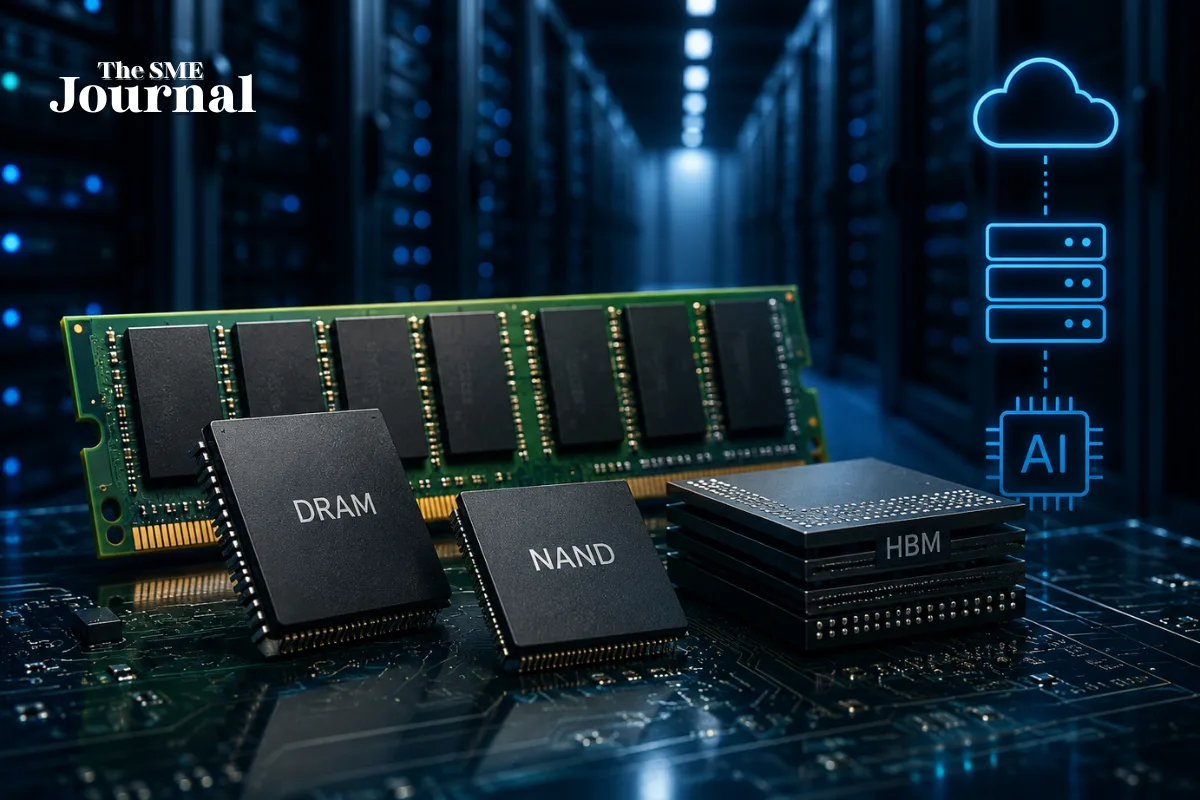
The artificial intelligence boom is creating a new pressure point for the global technology industry: memory chips.
As technology companies race to build larger AI data centers, demand for DRAM, NAND and high-bandwidth memory (HBM) is rising rapidly. The result is a tightening supply market that is beginning to affect not only AI infrastructure but also PCs, smartphones, servers, storage devices and other electronics.
Recent industry analysis indicates that the memory shortage could persist for years because manufacturers are directing more production capacity toward high-value AI memory while new manufacturing capacity takes time to build.
AI Is Changing What the Memory Industry Produces
Traditional memory chips are used across almost every category of electronics. But AI systems have changed the economics of the market.
Modern AI accelerators require extremely fast memory to move huge amounts of data between processors and storage. High-bandwidth memory, or HBM, has therefore become one of the most strategically important components in AI infrastructure.
HBM is built by stacking multiple DRAM dies vertically, allowing it to deliver much higher bandwidth in a compact package. This makes it particularly valuable for AI training and inference systems.
As AI infrastructure spending accelerates, memory manufacturers are allocating more resources toward HBM and other data-center products.
SK hynix, for example, has described 2026 as an HBM-led memory "supercycle," reflecting expectations for strong demand across HBM, DRAM and NAND.
Conventional DRAM and NAND Are Feeling the Pressure
The challenge is that semiconductor manufacturing capacity cannot be shifted instantly.
When manufacturers prioritize HBM and other AI-focused products, less capacity can remain available for conventional DRAM and NAND products used in consumer electronics.
That is creating a difficult situation for companies that depend on memory chips for laptops, smartphones, gaming devices and enterprise hardware.
The Financial Times reports that prices for memory products have risen sharply as AI data-center demand outpaces supply, while significant new capacity is not expected to arrive until around 2028.
Industry research has also warned that the shortage could extend toward the end of the decade, making the current situation different from a short-term inventory correction.
Data Centers Are Getting Priority
The reason is straightforward: AI data centers are willing to pay for high-performance components that can improve computing efficiency.
For memory manufacturers, HBM and enterprise-grade memory can offer more attractive economics than some traditional consumer products.
This is already influencing corporate strategies.
Micron announced in 2025 that it would exit its Crucial consumer business, citing the surge in AI-driven data-center demand for memory and storage and the need to focus resources on larger, faster-growing strategic markets.
The company has simultaneously been expanding its U.S. memory manufacturing plans, including new DRAM capacity and future HBM packaging capabilities designed to address expected AI demand.
New Factories Will Take Time
Building additional memory production capacity is not a quick solution.
New semiconductor facilities require billions of dollars, specialized equipment, cleanrooms, skilled workers and lengthy qualification processes. Even when investment decisions are made today, meaningful production capacity can take several years to arrive.
Micron's New York megafab, for example, is planned as a major expansion of U.S. memory manufacturing, with the company describing the project as part of its strategy to meet growing AI-related demand.
SK hynix is also expanding manufacturing and advanced packaging capacity in South Korea and the United States to strengthen its ability to supply AI memory.
That long investment cycle means supply could remain tight even as manufacturers spend heavily on expansion.
Electronics Manufacturers Face Higher Costs
The memory shortage is no longer limited to semiconductor companies.
Computer manufacturers, smartphone makers, server companies and electronics brands are increasingly exposed to higher component costs.
Hewlett Packard Enterprise recently raised its financial outlook because of strong AI-related demand but also highlighted supply constraints involving memory, NAND, CPUs and drives.
For manufacturers, this creates a difficult balancing act.
They must secure enough components to meet customer demand while dealing with higher prices and uncertainty over future availability.
Some of those additional costs can eventually reach consumers through higher prices for laptops, smartphones, gaming devices and other electronics.
China Is Also Expanding Its Memory Presence
The shortage is occurring alongside a major shift in the global memory market.
Chinese manufacturers are increasingly expanding their position in DRAM and NAND, challenging established players such as Samsung, SK hynix and Micron.
ChangXin Memory Technologies, or CXMT, has emerged as China's leading DRAM producer and has benefited from strong demand and rising memory prices. Recent market data indicates that Chinese companies are gaining share even as the overall memory market expands rapidly.
This could add another layer of complexity to the global semiconductor industry, particularly as governments continue to use export controls, subsidies and industrial policies to secure strategic technology supply chains.
A New Memory Race Is Underway
The semiconductor industry has traditionally competed around transistor density and processing performance.
The AI era is adding another battlefield: memory.
Companies are now competing to develop faster HBM generations, improve packaging technology, expand DRAM production and create new memory architectures capable of handling increasingly demanding AI workloads.
SK hynix has been expanding its portfolio beyond HBM into advanced NAND, CXL-based memory and other technologies designed for AI infrastructure.
The company has also entered a long-term AI memory partnership with NVIDIA to develop and optimize next-generation memory solutions.
What Does the Shortage Mean for Businesses?
For businesses outside the semiconductor industry, the current situation could have significant consequences.
Companies that rely heavily on computers, servers, storage or specialized electronics may need to reconsider their hardware procurement strategies.
For SMEs, the biggest challenges could include:
- Higher prices for computers and servers
- Longer lead times for hardware
- Increased costs for SSDs and memory modules
- Difficulty securing high-capacity components
- Greater pressure on technology upgrade budgets
- Increased need for long-term supplier relationships
At the same time, the shortage creates opportunities for companies operating around the semiconductor ecosystem.
Businesses involved in chip packaging, testing, semiconductor equipment, logistics, materials, electronics manufacturing and supply-chain management could benefit as manufacturers attempt to expand capacity.
Could the Shortage Last Until 2029?
There is growing concern that the memory crunch will not disappear quickly.
Deloitte recently warned that the combination of strong demand, high prices and constrained production capacity could keep the memory market tight well into the latter part of the decade.
That does not necessarily mean prices will continue rising indefinitely. Semiconductor markets are cyclical, and manufacturers eventually respond to high prices by investing in additional capacity.
The problem is timing.
If AI infrastructure continues expanding faster than new factories can produce memory, the market could remain under pressure for several years.
The Bigger Picture
The current memory shortage is more than a temporary semiconductor supply problem.
It reflects a fundamental change in the technology industry.
AI data centers are becoming some of the world's largest consumers of advanced computing components, and memory is increasingly central to their performance. As companies build larger AI systems, the competition for HBM, DRAM and NAND capacity is likely to intensify.
For semiconductor manufacturers, this represents a major growth opportunity.
For electronics companies and consumers, however, it could mean higher costs and tighter supply.
The companies best positioned for the next phase of the AI economy may not simply be those producing the fastest processors. They may also be the companies capable of making, packaging and supplying the memory needed to keep those processors running.
Frequently Asked Questions
1. Why is there a memory chip shortage?
The rapid expansion of AI data centers is increasing demand for HBM, DRAM and NAND, while manufacturers have limited capacity and are prioritizing higher-value AI memory products.
2. What is HBM?
High-bandwidth memory is a type of DRAM designed to provide extremely high data-transfer rates for applications such as AI and high-performance computing.
3. Will the memory shortage affect smartphones and laptops?
Yes. Tight supplies and higher memory prices can increase manufacturing costs and potentially lead to higher prices or changes in device specifications.
4. Which companies dominate the memory market?
Samsung, SK hynix and Micron remain the major global memory manufacturers, while Chinese companies such as CXMT are expanding their presence.
5. How long could the memory shortage last?
Industry analysts expect tight conditions to persist for several years, with some forecasts pointing to continued pressure toward 2028 or 2029 as new production capacity comes online.







.webp)