
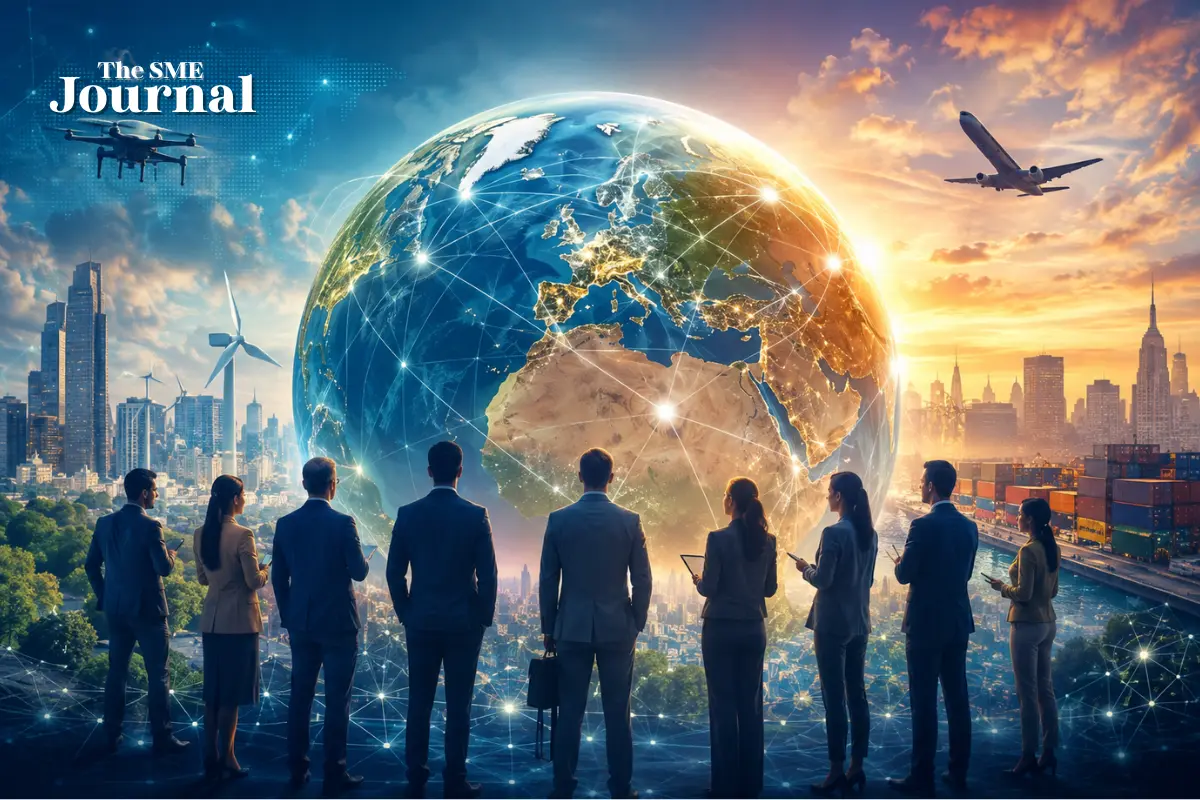
Entrepreneurship is no longer limited by national borders. A business can be founded in one country, develop technology in another, manufacture products somewhere else and serve customers across the world.
This changing business environment has created a new generation of entrepreneurs who think globally from the beginning. For The SME Journal, the global perspective on entrepreneurship is increasingly important because small and medium-sized businesses are becoming significant participants in international markets.
The Rise of the Global Entrepreneur
Technology has fundamentally changed how entrepreneurs build companies.
Cloud computing, artificial intelligence, digital payments, social media and e-commerce have reduced many of the traditional barriers to entering international markets. A small business can now reach customers thousands of miles away without opening a physical office in every market.
This has created opportunities for entrepreneurs in both developed and emerging economies.
A founder in India can sell services to businesses in Europe. A technology startup in Singapore can attract customers in North America. A consumer brand in Africa can use digital platforms to reach customers around the world.
The result is a more interconnected entrepreneurial ecosystem.
Why a Global Perspective Matters
Thinking globally does not necessarily mean expanding into every country. Instead, it means understanding how international trends can influence a business.
Entrepreneurs increasingly need to monitor:
- Global consumer behavior
- International technology trends
- Currency and economic conditions
- Supply-chain developments
- Regulatory changes
- Geopolitical risks
- Cross-border investment
- International competition
Understanding these factors can help businesses identify opportunities while preparing for potential challenges.
Technology Is Removing Traditional Barriers
Digital technology has become one of the biggest drivers of global entrepreneurship.
Artificial intelligence can help businesses automate repetitive tasks, analyze customer behavior and create content. E-commerce platforms allow companies to sell beyond their local markets, while digital communication tools make international collaboration easier.
For small businesses, these technologies can be particularly valuable because they provide access to capabilities that previously required significant financial resources.
However, technology alone does not guarantee international success. Entrepreneurs still need strong products, reliable operations, customer trust and a clear understanding of local markets.
The Growing Importance of Emerging Markets
Global entrepreneurship is also becoming increasingly diverse.
For decades, much of the world's startup attention was concentrated around established technology hubs. Today, entrepreneurs from countries across Asia, Africa, Latin America and the Middle East are building businesses for both domestic and international customers.
India is a particularly important example.
The country's large consumer market, expanding digital infrastructure and growing startup ecosystem have created opportunities across fintech, technology, healthcare, education, e-commerce and other industries.
Other emerging economies are experiencing similar changes as internet access, digital payments and mobile technology expand.
Globalization Comes With New Challenges
A global business environment creates opportunities, but it also introduces additional risks.
Entrepreneurs entering international markets must understand differences in culture, consumer expectations, taxation, employment regulations and data protection.
Supply chains can also become vulnerable to geopolitical tensions, trade restrictions, natural disasters and changes in transportation costs.
Currency fluctuations can affect profitability, while economic slowdowns in major markets can influence demand.
For this reason, international expansion requires more than ambition. It requires research, flexibility and careful planning.
AI and the Next Generation of Global Businesses
Artificial intelligence is expected to play an increasingly important role in international entrepreneurship.
AI-powered tools can help small businesses conduct market research, translate communications, analyze data and provide customer support. This can make international operations more accessible to companies that previously lacked large teams.
At the same time, businesses need to use AI responsibly.
Accuracy, privacy, cybersecurity and transparency are becoming important considerations as companies integrate AI into everyday operations.
The entrepreneurs most likely to benefit from AI will not simply be those who adopt the most tools. They will be those who understand where technology can create genuine business value.
Sustainability Is Becoming a Global Business Priority
Another major shift is the growing importance of sustainability.
Consumers, investors and governments are increasingly paying attention to environmental and social issues. Businesses are therefore under greater pressure to examine how they source materials, manufacture products, use energy and manage waste.
For entrepreneurs, sustainability can represent both a responsibility and an opportunity.
Companies that develop efficient technologies, sustainable products and responsible supply chains may find new markets while responding to changing customer expectations.
What Global Entrepreneurs Can Learn
A successful global entrepreneur needs more than a good idea.
Several qualities are becoming increasingly important:
Adaptability: Markets can change quickly, and businesses must be prepared to adjust.
Cultural awareness: A strategy that works in one country may not work in another.
Digital capability: Technology has become central to international communication, marketing and operations.
Risk management: Global businesses need plans for economic, political and supply-chain uncertainty.
Customer understanding: International growth starts with understanding the people a company wants to serve.
Long-term thinking: Sustainable global businesses are generally built through consistent execution rather than rapid expansion alone.
The Future of Global Entrepreneurship
The future of entrepreneurship is likely to become even more interconnected.
A startup's competitors may come from anywhere. Its customers may live in multiple countries. Its employees may work remotely from different regions, and its technology may depend on international infrastructure.
This means entrepreneurs must increasingly think beyond their immediate geography.
For readers of The SME Journal, the global perspective is not simply about international business. It is about understanding the forces shaping businesses everywhere—from artificial intelligence and digital commerce to sustainability, investment and changing consumer behavior.
The entrepreneurs who understand these shifts early may be better positioned to identify opportunities in the next phase of the global economy.
Conclusion
Entrepreneurship is entering an era in which borders matter less to business creation but remain important to business strategy.
Technology has made global markets more accessible, while emerging economies are producing ambitious entrepreneurs and innovative companies.
Yet global success requires more than reaching international customers. Businesses must understand different markets, manage uncertainty and build trust across cultures.
The central lesson is simple: think globally, understand locally and build for the long term.
For The SME Journal, this global perspective provides an important lens through which to understand the entrepreneurs, businesses and ideas shaping tomorrow's economy.
Frequently Asked Questions
What is a global perspective in entrepreneurship?
A global perspective means understanding international markets, technologies, economic trends, consumer behavior and risks when making business decisions.
Why is global thinking important for entrepreneurs?
Global thinking helps entrepreneurs identify opportunities beyond their local markets and prepare for international competition and changing economic conditions.
How is technology helping small businesses go global?
E-commerce, cloud computing, AI, digital payments and online communication allow small businesses to reach international customers and collaborate across borders.
What are the biggest challenges of global entrepreneurship?
Common challenges include cultural differences, regulations, currency fluctuations, geopolitical risks, supply-chain disruptions and competition.
How can AI help global entrepreneurs?
AI can support market research, translation, customer service, data analysis, marketing and business automation, helping smaller companies operate more efficiently.
What is the future of global entrepreneurship?
The future is likely to be increasingly digital, interconnected and technology-driven, with entrepreneurs competing and collaborating across international markets.







.webp)