
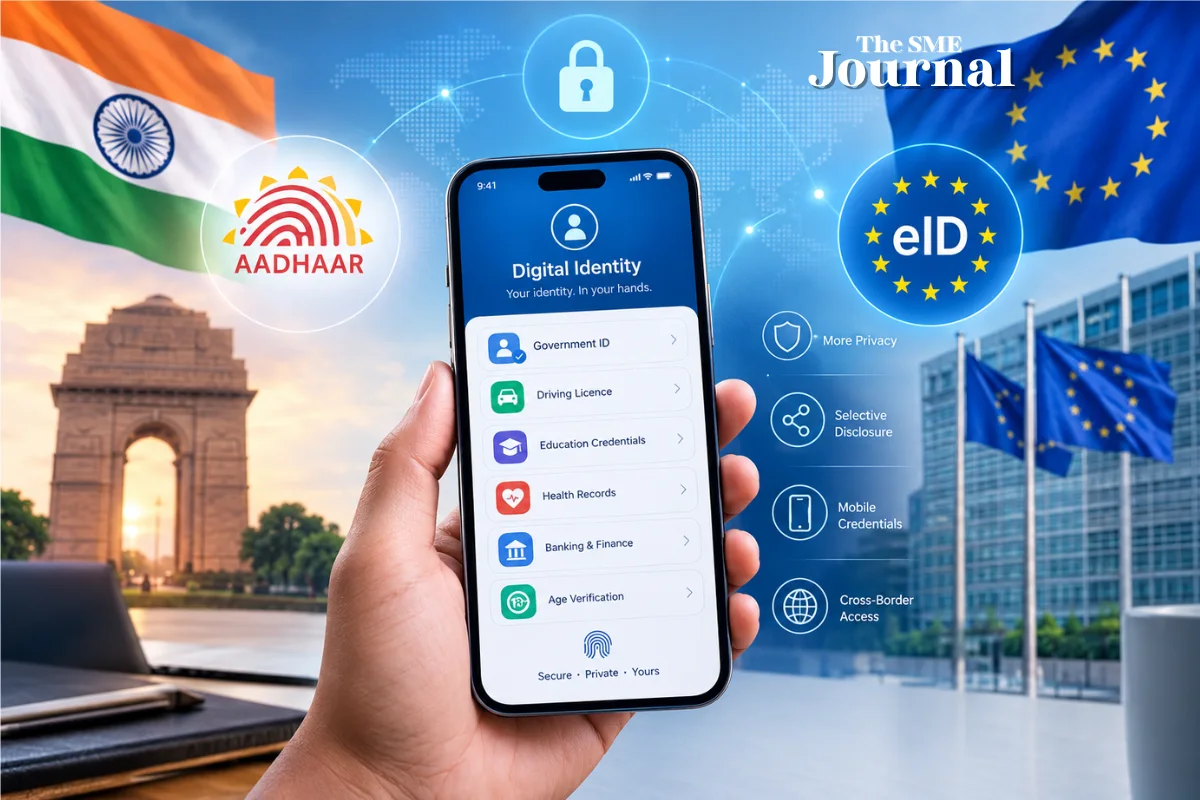
Digital identity is rapidly moving beyond passwords, physical documents and repeated KYC checks. Governments and technology companies are increasingly building systems that allow people to prove who they are directly from their smartphones—while sharing only the information required for a particular transaction.
The trend is gaining momentum in both India and Europe, where digital identity infrastructure is becoming an important part of the broader digital economy.
In India, Aadhaar credentials are moving further into digital wallets. Google Wallet began supporting Aadhaar Verifiable Credentials in 2026, allowing users to store a digital version of their identity credential on a smartphone. Google says the system is designed around privacy features such as selective disclosure, allowing users to share specific information without necessarily exposing their entire identity record.
Meanwhile, the European Union is preparing for a major expansion of its own digital identity infrastructure, with Member States required to make European Digital Identity Wallets available by the end of 2026.
From Physical IDs to Digital Credentials
Traditional identity verification often requires people to present physical documents or repeatedly provide the same personal information to different organisations.
Digital identity wallets aim to change that model.
A smartphone could eventually hold verified credentials such as:
- Government-issued identity information
- Driving licences
- Educational qualifications
- Professional credentials
- Proof of age
- Health-related documents
- Business credentials
- Digital signatures
Instead of handing over an entire document, users can potentially provide only the information necessary for a particular service.
For example, a website that only needs to confirm whether someone is over 18 may not need to receive the person's full date of birth or home address.
This concept—often called selective disclosure—is becoming one of the most important ideas in modern digital identity.
India Pushes Aadhaar Toward a Digital-First Model
India already has one of the world's largest digital identity infrastructures through Aadhaar.
The next stage is making identity credentials more convenient and interoperable.
Google announced in January that Aadhaar Verifiable Credentials would be available through Google Wallet, while its April update confirmed support for Aadhaar credentials in India. The technology is based on standards including ISO 18013-5 and the W3C Digital Credentials API, while Google also highlighted zero-knowledge-proof technology for certain verification scenarios.
The development could make identity verification easier for everyday activities such as financial services, travel, age verification and access to online services.
But convenience is only one part of the equation.
The bigger challenge is ensuring that digital identity systems remain secure while giving individuals meaningful control over their personal information.
Europe Is Building a Digital Identity Wallet for 450 Million People
Europe is taking a broader regulatory approach.
The European Digital Identity Wallet (EUDI Wallet) is designed to allow citizens and residents to prove their identity, store official documents, share verified credentials and create legally binding electronic signatures.
The European Commission says Member States will make wallets available to citizens, residents and businesses by the end of 2026. More than 550 companies and public authorities across 26 EU Member States and associated countries have participated in large-scale pilot projects testing different use cases.
The European Telecommunications Standards Institute has also released standards supporting the wallets, describing the system as infrastructure that could allow people to manage identity, qualifications and official documents from a secure digital wallet.
That could eventually make cross-border digital services considerably easier.
A European citizen could, for example, use a verified digital credential to access banking, education, government or travel services in another EU country without creating an entirely new identity profile.
Security Is Becoming Just as Important as Convenience
The expansion of digital identity also creates a major cybersecurity challenge.
A stolen physical document is serious, but a compromised digital identity could potentially affect multiple services simultaneously.
That is why European regulators are placing increasing emphasis on certification and cybersecurity.
The European Union Agency for Cybersecurity, ENISA, is supporting the development of certification schemes for European Digital Identity Wallets. Member States are expected to provide at least one certified wallet by the end of 2026.
This reflects an important change in the identity industry: digital identity is no longer simply an authentication problem. It is becoming a cybersecurity, privacy and infrastructure issue.
Businesses Could Be Major Beneficiaries
Digital identity could significantly change how companies onboard and verify customers.
Banks, fintech companies, insurance providers, marketplaces, travel businesses and online platforms spend substantial resources on identity verification and KYC procedures.
A trusted digital identity wallet could reduce some of this friction.
The European Commission expects digital identity wallets to help businesses reduce authentication costs, improve security and create opportunities for new digital services.
For SMEs, this could be particularly important.
A small business may not have the resources to build sophisticated identity-verification infrastructure internally. Standardised digital credentials could allow smaller companies to access reliable verification services without building everything from scratch.
Digital Identity Could Also Change KYC
India faces a slightly different challenge.
The country already has extensive digital identity infrastructure, but questions remain around how identity and KYC information is reused across different institutions.
A recent analysis of India's digital identity and KYC systems highlighted fragmentation between agencies and argued for greater reuse of valid verification records, standardised rules and consent-based data exchange.
That points toward the next major phase of digital identity: not simply creating a digital ID, but making that ID usable across different services without forcing people to repeatedly submit the same information.
The Rise of AI Makes Digital Identity Even More Important
Artificial intelligence is adding another layer to the identity debate.
AI systems can increasingly automate customer onboarding, fraud detection and transaction monitoring. India is also exploring AI-enabled payment systems that could eventually authenticate users and authorise certain transactions with less manual interaction.
But greater automation also creates new questions.
Who authorised an AI agent to act on someone's behalf?
How can a business verify that an AI-powered transaction actually came from an authorised user?
And how can individuals revoke an AI system's access to their digital credentials?
These questions suggest that the future of digital identity may extend beyond proving who a person is to proving which person, device or AI agent is authorised to act.
What Comes Next?
The next few years could mark a major transformation in the way people interact with governments and businesses online.
India is building on the scale of Aadhaar and its wider digital public infrastructure, while Europe is developing a common regulatory and technical framework for interoperable digital wallets.
The underlying goal is similar: make identity verification faster, more secure and less dependent on repeatedly sharing large amounts of personal information.
However, trust will determine whether digital identity succeeds.
People will need confidence that their credentials cannot easily be stolen, tracked or misused. Businesses will need reliable standards and interoperability. Governments will need strong privacy protections and transparent rules.
If those conditions are met, the smartphone could become more than a payment device or communication tool. It could become a secure digital passport for everyday life.
For businesses and SMEs, the emergence of digital identity represents more than a technology trend. It could reshape customer onboarding, KYC, payments, fraud prevention and access to online services—creating a new digital infrastructure for the global economy.
Frequently Asked Questions
1. What is digital identity?
Digital identity is a way of proving who you are electronically using verified credentials rather than relying solely on physical documents.
2. How is Aadhaar becoming a digital identity?
Aadhaar Verifiable Credentials can be stored in supported digital wallets, allowing users to present verified identity information digitally.
3. What is the European Digital Identity Wallet?
It is a digital wallet framework that will allow EU citizens and residents to store and share verified credentials and access public and private services digitally.
4. Is digital identity safe?
Security depends on the technology, implementation and safeguards used. Modern systems increasingly use encryption, strong authentication, selective disclosure and certification frameworks to reduce risks.
5. How can digital identity help SMEs?
It could simplify customer verification, reduce KYC friction, lower authentication costs and make it easier for SMEs to provide trusted online services.







.webp)