
Companies are generating and storing more data than ever. Customer records, emails, analytics, AI workloads, videos, backups and countless business applications all add to the mountain of information sitting inside corporate IT environments.
But new research from CTERA points to an unexpected problem: a large share of that storage may not actually be doing much.
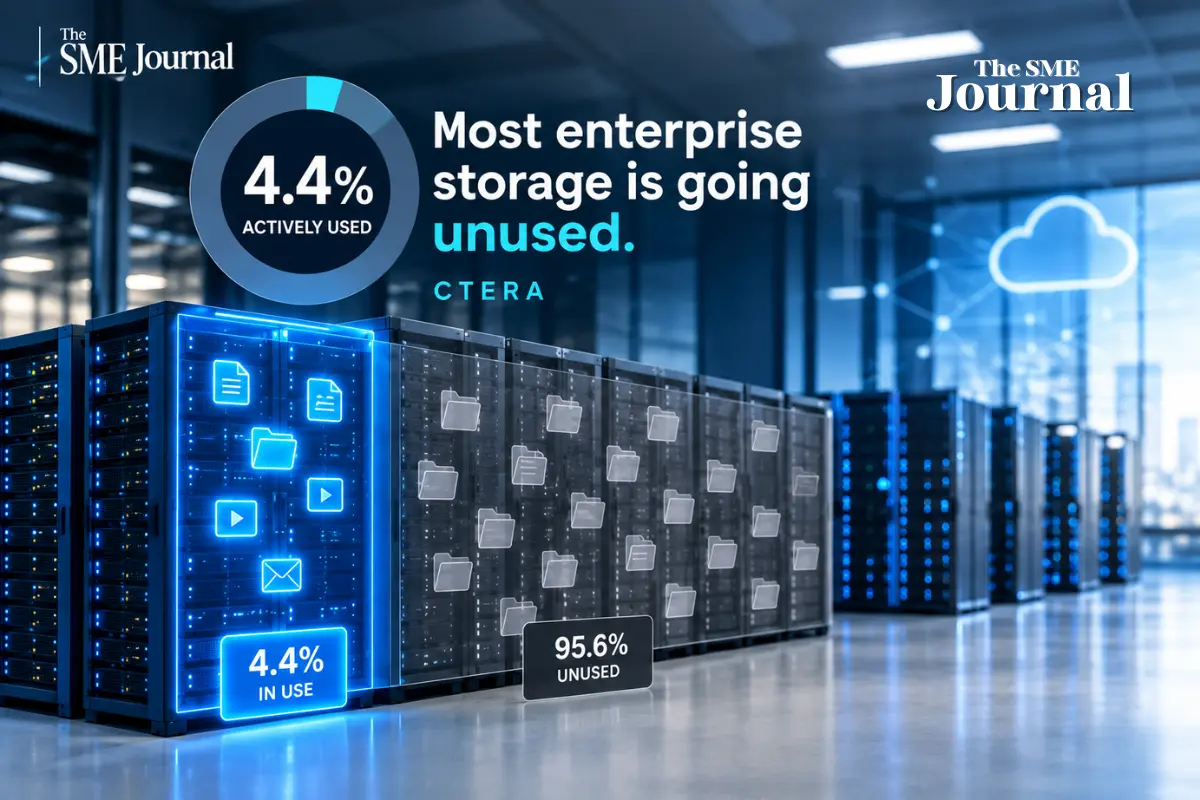
According to CTERA's research, just 4.4% of enterprise storage is actively used. The finding highlights a growing challenge for organizations: businesses may be investing heavily in infrastructure while struggling to understand which data is genuinely valuable and which information is simply sitting there.
The Hidden Cost of Keeping Everything
It is easy to assume that unused storage is harmless. After all, if a company has plenty of space available, why worry about it?
The reality is more complicated.
Unused or forgotten data can still create costs. Organizations have to maintain the infrastructure holding it, protect it, back it up and potentially move it when systems are upgraded or migrated.
Over time, those small costs can become significant, particularly for large enterprises managing data across multiple locations and cloud environments.
AI Is Making the Situation More Complicated
The timing of CTERA's findings is particularly interesting because businesses are simultaneously preparing for an explosion in AI-related data.
Generative AI, machine learning and AI agents require access to large quantities of information. Companies are therefore buying more storage and building larger data environments.
But simply adding storage doesn't solve the underlying problem.
If organizations cannot identify their important data, understand where it lives or determine whether it is still useful, expanding storage can eventually become an expensive way of managing clutter.
Not All Data Has the Same Value
One of the biggest changes happening in enterprise data management is the realization that more data does not automatically mean more business value.
A company's customer information may be extremely important. An old duplicate file from eight years ago may not be.
Yet both can occupy storage space.
This makes data classification increasingly important. Businesses need ways to identify sensitive information, frequently used information, outdated material and data that can potentially be archived or removed.
The Cloud Hasn't Eliminated the Problem
Moving information to the cloud may make storage easier to scale, but it doesn't automatically make data management easier.
Companies can end up with information spread across cloud platforms, on-premises systems, employee devices and different business applications.
That creates another problem: visibility.
IT teams may know how much storage they have, but understanding exactly what is stored, who uses it and whether it still needs to be retained can be much harder.
What Businesses Can Learn From the Research
CTERA's findings offer a simple lesson for companies entering the AI era: before buying more storage, it may be worth taking a closer look at the data they already have.
That could mean identifying duplicate files, improving data classification, moving rarely used information into appropriate archives and establishing clearer policies around data retention.
For smaller businesses, the lesson can be even more practical. Data doesn't have to reach petabyte scale before poor organization becomes expensive.
The Next Big Data Challenge May Be Doing More With Less
The big data conversation has traditionally focused on collecting more information and building bigger systems to store it.
That approach may be changing.
As AI pushes organizations to create and process even more information, businesses will increasingly need to ask a different question: Which data actually deserves our attention?
The answer could help companies reduce unnecessary infrastructure costs while making their most valuable information easier for people and AI systems to find.
For The SME Journal, the CTERA research is a reminder that the future of big data isn't necessarily about having more data. It may be about becoming much smarter about the data businesses already own.
Frequently Asked Questions
1. What did CTERA's research find about enterprise storage?
CTERA reported that only 4.4% of enterprise storage in its research was actively used, highlighting the scale of potentially underutilized storage.
2. Why do companies keep unused data?
Businesses often retain old files because of compliance requirements, backups, historical records, uncertainty about deletion and the difficulty of determining what information is still valuable.
3. Does AI increase the need for data storage?
Yes. AI systems can generate, process and retain very large amounts of information, increasing demand for storage and data infrastructure.
4. How can businesses manage unused data more effectively?
Organizations can improve data classification, identify duplicates, establish retention policies, archive rarely accessed information and regularly review their storage environments.









.webp)