
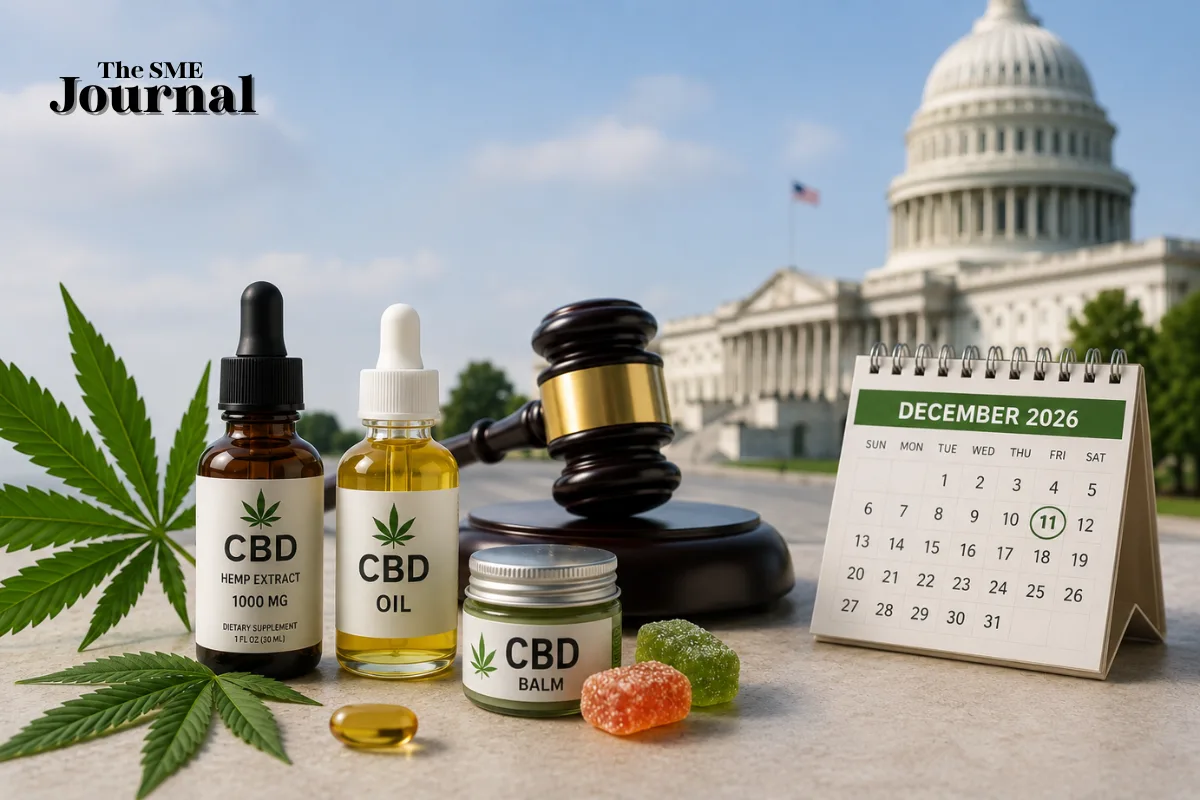
The U.S. CBD and hemp industry is entering another period of uncertainty after lawmakers delayed the implementation of new federal restrictions on hemp-derived THC products, giving businesses additional time to prepare for a major regulatory shift.
President Donald Trump recently signed legislation delaying the scheduled implementation of the new hemp restrictions until December 11, 2026. The move gives Congress more time to establish a regulatory framework for hemp-derived products that contain intoxicating cannabinoids.
The development could have significant consequences for CBD brands, hemp farmers, manufacturers and retailers across the United States.
Why the New Rules Matter for CBD Businesses
The issue goes beyond traditional CBD oils and gummies.
Under the new federal definition scheduled to take effect in November, certain hemp-derived products containing more than 0.4 milligrams of total naturally occurring THC and other qualifying cannabinoids per container could fall outside the federal definition of legal hemp.
The original implementation date was November 12, 2026, but the latest legislation has pushed the deadline to December 11.
That one-month delay may sound small, but it gives lawmakers and businesses additional time to negotiate how products such as full-spectrum CBD products and low-dose THC beverages should be regulated.
What This Means for the CBD Market
CBD, or cannabidiol, is a non-intoxicating cannabinoid derived from cannabis and hemp.
However, many full-spectrum CBD products contain naturally occurring THC in addition to CBD. Some products marketed within the broader hemp industry also contain other cannabinoids that can have intoxicating effects.
That has created a complicated regulatory environment.
The 2018 Farm Bill removed hemp containing no more than 0.3% delta-9 THC on a dry-weight basis from the federal definition of marijuana. However, the FDA retained authority over hemp-derived products sold as foods, supplements and drugs.
As a result, a product can potentially meet the federal definition of hemp while still facing restrictions under FDA rules.
FDA's Position Remains Important
The FDA continues to take a cautious position toward CBD products.
The agency says it has approved Epidiolex, a prescription medicine containing purified CBD, for certain seizure disorders. But it has not approved CBD generally as an ingredient for conventional foods or dietary supplements.
The FDA has also warned companies against marketing CBD products with unsupported medical claims.
This means businesses operating in the CBD sector face two different challenges: determining whether their products fit within federal hemp rules and ensuring their marketing complies with FDA requirements.
A Major Moment for Small Businesses
The regulatory debate is particularly important for small and medium-sized businesses.
Thousands of entrepreneurs have built companies around hemp-derived products, including CBD oils, gummies, beverages, cosmetics and wellness products.
An immediate prohibition or significant restriction could force some businesses to reformulate products, change packaging, alter distribution strategies or leave certain markets altogether.
During congressional discussions, lawmakers have argued that an abrupt ban could hurt farmers and small businesses, while others have emphasized the need for stronger safeguards around intoxicating hemp products.
For entrepreneurs, the next few months could therefore be critical.
The Industry May Be Moving Toward Regulation Rather Than Prohibition
The latest delay suggests that lawmakers may be looking for a middle ground.
Rather than simply eliminating the emerging hemp-derived cannabinoid market, Congress now has additional time to consider rules covering product potency, labeling, testing, age restrictions and consumer safety.
That could eventually provide businesses with something the industry has lacked for years: greater regulatory clarity.
For established CBD companies, clear rules could make it easier to invest, manufacture and expand. For consumers, standardized testing and labeling could make it easier to understand exactly what they are buying.
What Comes Next?
The December deadline puts pressure on lawmakers to develop a clearer framework before the new restrictions take effect.
For CBD companies, the immediate priority is likely to be reviewing product formulations and monitoring federal and state-level developments.
The industry should also expect continued differences between states. Federal changes do not necessarily eliminate individual state restrictions, meaning businesses selling CBD products across the country may continue to face a complicated patchwork of requirements.
For now, the CBD market remains open—but the rules governing the wider hemp-derived cannabinoid industry are moving toward a significant transformation.
The biggest question is no longer whether the U.S. will regulate hemp-derived cannabinoids. It is what that regulatory framework will ultimately look like.
FAQs
1. Is CBD still legal in the U.S.?
Federal CBD rules are complicated. Hemp was federally removed from the controlled-substance definition under the 2018 Farm Bill, but the FDA still regulates CBD products that fall under federal food, drug and supplement laws.
2. Will the new hemp restrictions ban CBD?
Not necessarily. The major changes are focused on how hemp and hemp-derived cannabinoid products are defined, particularly products containing certain levels of THC and other cannabinoids.
3. Why was the new hemp restriction delayed?
Congress delayed implementation to give lawmakers additional time to develop regulations for hemp-derived THC and related products.
4. What does the change mean for CBD businesses?
Companies may need to review formulations, labeling, testing and product portfolios as the federal framework develops.
5. When is the new deadline?
The implementation of the new hemp restrictions has been delayed until December 11, 2026, according to recent reporting.









.webp)