
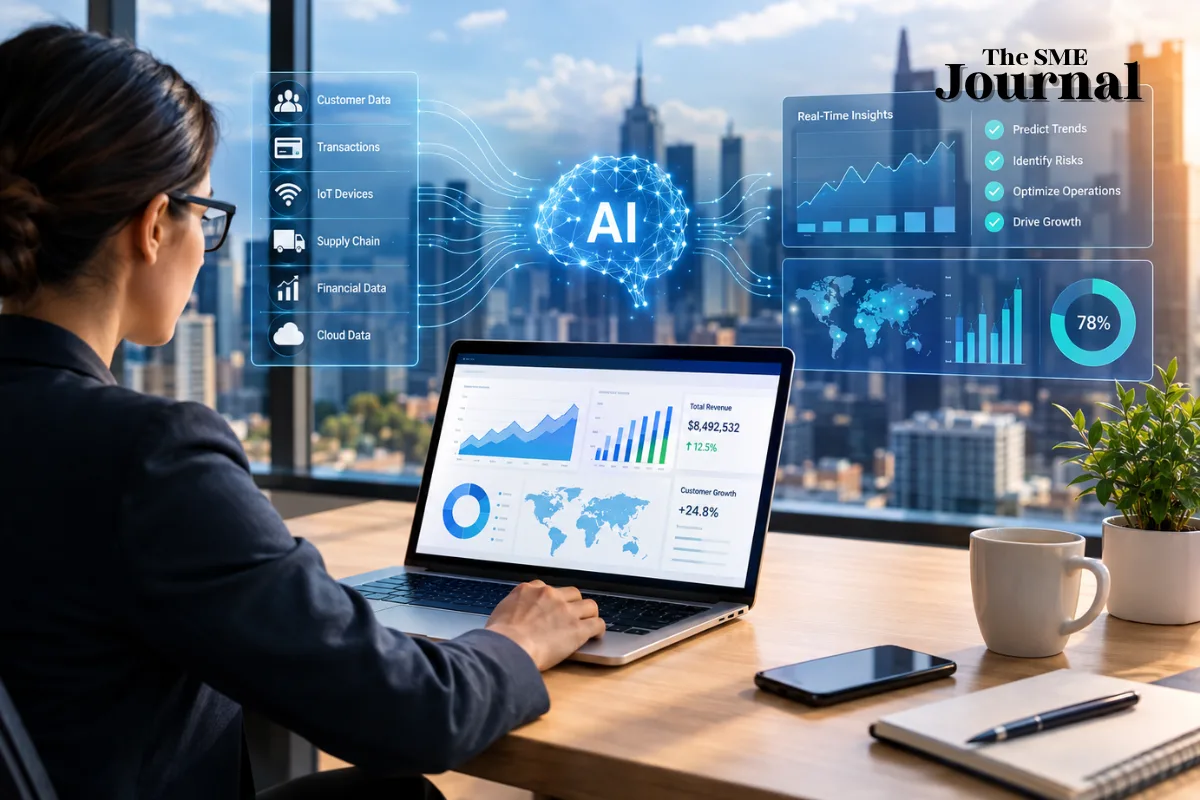
Data has become one of the most valuable resources for businesses, but simply having a lot of it is no longer enough. Companies today are looking for faster and smarter ways to understand their information and use it to make better decisions.
From customer purchases and website activity to financial records, connected devices and supply-chain systems, businesses are generating enormous amounts of information every day. The challenge is figuring out what matters and, more importantly, what to do with it.
That is where big data and analytics are becoming increasingly important.
From Reports to Real-Time Insights
For many years, businesses relied on reports and dashboards to understand what had already happened. A sales team could look at last month's numbers, while executives might review quarterly performance before deciding what needed to change.
That approach is beginning to evolve.
Modern analytics platforms can process information much faster, giving businesses a clearer picture of what is happening right now. Companies can monitor changing customer behavior, identify unusual transactions, track inventory and spot operational problems before they become larger issues.
The goal is no longer just to answer, "What happened?"
Businesses increasingly want to know, "Why did it happen, and what should we do next?"
AI Is Giving Analytics a New Role
Artificial intelligence is playing a major role in this shift.
Instead of requiring employees to build complicated reports or understand advanced data tools, AI-powered analytics systems can allow users to ask questions in everyday language.
A manager, for example, could ask which products have seen the biggest drop in sales and what might be causing it. An AI-enabled system can analyze relevant information and present the findings in a much easier-to-understand format.
This could make data analysis useful to a much wider group of employees, not just data scientists and technical teams.
The combination of AI and analytics is also helping businesses move toward more automated decision-making. In areas such as customer service, finance, marketing and supply-chain management, systems can identify patterns and recommend actions with less human intervention.
More Data Does Not Always Mean Better Decisions
There is, however, another side to the story.
Companies can collect enormous quantities of data, but if that information is outdated, incomplete or inaccurate, the results can be misleading.
This is becoming particularly important as businesses use their data to power AI systems. An AI model can only work as well as the information it receives.
That is why organizations are paying greater attention to data quality, security and governance. Businesses need to know where their information comes from, who can access it and whether it can be trusted.
For companies moving deeper into AI, these issues are no longer just technical concerns. They can directly affect business performance.
Businesses Are Investing in Data Infrastructure
The growing interest in AI is also increasing demand for cloud computing, data centers and analytics infrastructure.
Companies need reliable systems capable of storing and processing huge volumes of information. At the same time, they want those systems to deliver insights quickly enough to support everyday business decisions.
Market research continues to point toward strong growth in the global big data and analytics market as organizations invest in cloud platforms, AI and advanced analytics.
For smaller businesses, this trend could also create opportunities. Cloud-based analytics tools are making sophisticated data capabilities more accessible without requiring every company to build a large technology department.
The Human Side of Data
Despite all the talk about automation, people remain an important part of the process.
Data can show that sales are falling, customers are leaving or costs are rising. But understanding the reasons behind those changes often requires experience and context.
The strongest businesses are therefore unlikely to be those that simply hand every decision over to an algorithm. Instead, they will be the ones that combine technology with human judgment.
Analytics can reveal the pattern. AI can help explain it. But business leaders still need to decide what action makes sense.
What the Future Could Look Like
Big data and analytics are moving toward a future where information is available faster, insights are easier to understand and more decisions can be supported by AI.
The biggest change may not be the amount of data businesses collect, but how quickly they can turn that data into something useful.
For companies, the message is becoming clear: having data is only the beginning. Knowing how to use it could become one of the biggest competitive advantages of the coming years.
5 FAQs
1. What is big data analytics?
Big data analytics involves examining large amounts of information to find useful patterns, trends and insights that can help businesses make decisions.
2. How is AI changing analytics?
AI can analyze large datasets, identify patterns and present insights in simpler ways, allowing more employees to use data without advanced technical skills.
3. Why does data quality matter?
Poor or inaccurate data can produce unreliable results. Good-quality data is essential for meaningful analytics and trustworthy AI.
4. Can small businesses benefit from big data analytics?
Yes. Cloud-based analytics tools allow smaller businesses to use advanced data capabilities without making the same infrastructure investments as large corporations.
5. What is the future of big data and analytics?
The industry is moving toward real-time analytics, AI-powered insights, automation, stronger data governance and faster decision-making.







.webp)