
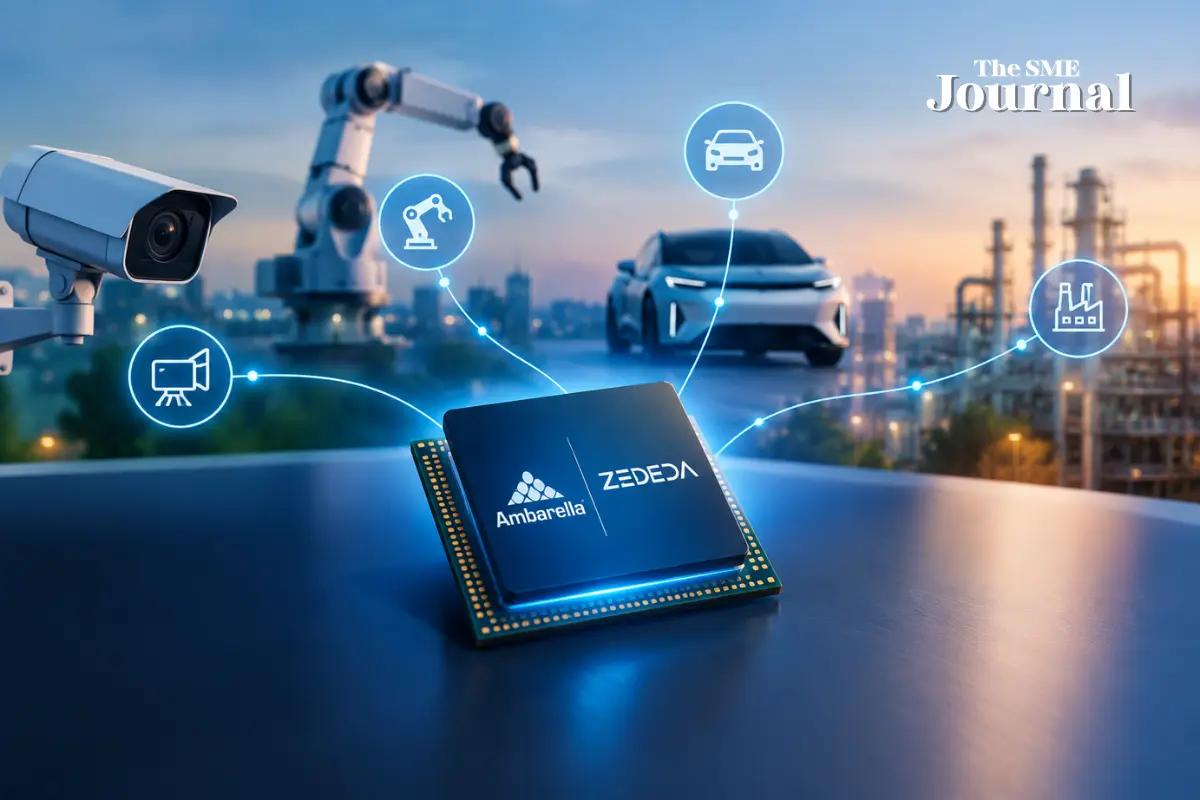
The next generation of IoT is becoming more intelligent, and a new partnership between Ambarella and ZEDEDA is looking to push that shift further.
Ambarella and ZEDEDA announced a strategic partnership on September 15, 2026, aimed at making it easier for businesses to deploy, manage and secure artificial intelligence across connected devices operating at the physical edge. The companies are targeting applications including cameras, robots, vehicles, industrial systems and other intelligent machines.
The idea is relatively simple: instead of treating AI devices as isolated pieces of hardware, businesses could manage large numbers of them through a centralized platform, much like they already manage cloud-based applications.
Bringing Cloud-Style Management to IoT
One of the biggest challenges with edge AI isn't necessarily getting an AI model to work. The harder part can be keeping thousands of devices updated, secure and operational once they are deployed in the real world.
That's where ZEDEDA's technology comes into the picture.
Under the partnership, ZEDEDA's open-source EVE-OS is now running on Ambarella's N1 family of edge generative AI system-on-chips, beginning with the N1-655. ZEDEDA's Edge Intelligence Platform can then be used to deploy, update and operate AI models on Ambarella-powered devices from a centralized control system.
For companies managing distributed IoT equipment, this could reduce the need for technicians to physically visit individual locations whenever software or AI models need to be changed.
Why This Matters for IoT
IoT devices have traditionally been good at collecting information. Cameras can capture video, sensors can measure conditions and machines can report their operating status.
Edge AI takes that capability a step further by allowing devices to process information locally.
For example, an intelligent camera could analyze video at the edge rather than sending every frame to a remote cloud server. A robot could process information from its surroundings locally, while an industrial machine could run AI models closer to the equipment generating the data.
The Ambarella-ZEDEDA partnership is focused on making those types of AI workloads easier to manage across large fleets of devices. The companies say their platform can support vision models, large language models and multimodal AI workloads on Ambarella-based systems.
Security and Remote Updates Take Center Stage
Managing connected devices at scale also creates a major security challenge.
An enterprise might have hundreds or thousands of cameras, robots or industrial devices operating in different locations. Keeping their software and AI models updated manually can become difficult and expensive.
The companies say their combined platform is designed to provide centralized management with security features and remote lifecycle management. ZEDEDA's platform can also deploy AI models through its Model Hub and monitor workloads after deployment.
This approach could be particularly relevant for industries where connected equipment is spread across factories, warehouses, transportation networks or other large physical environments.
From Smart Cameras to Physical AI
The partnership also reflects a broader movement in technology: AI is increasingly moving outside traditional data centers.
Ambarella develops AI chips designed for applications including computer vision, automotive systems, robotics and industrial equipment. The company says it has shipped more than 50 million AI chips cumulatively.
ZEDEDA, meanwhile, focuses on managing edge infrastructure and workloads. By bringing the two technologies together, the companies are attempting to create a path from AI development to deployment on physical devices.
At the AI Infrastructure Summit 2026, the companies demonstrated the integration using Ambarella's N1-655 platform. The demonstration included AI models from ecosystem partners such as Roboflow and Liquid AI, with ZEDEDA handling orchestration.
What It Could Mean for Businesses
For businesses adopting IoT, the development highlights an important change.
The value of connected devices is no longer limited to collecting and transmitting data. Increasingly, companies want those devices to understand information, make decisions locally and respond in real time.
But deploying AI across thousands of physical devices can become complicated if every device has to be managed separately.
A centralized edge-management platform could help businesses address that problem by giving IT and operations teams a common way to deploy software, update models and monitor devices.
That could be particularly useful for smart factories, logistics, robotics, intelligent security systems, automotive applications and connected infrastructure.
The Bigger IoT Picture
The Ambarella and ZEDEDA partnership is another sign that IoT is moving toward a more intelligent and autonomous model.
The combination of edge AI hardware, cloud-based orchestration and connected devices could allow more processing to happen closer to where data is created while still giving businesses centralized control.
For IoT operators, that means the future may not simply be about connecting more devices. It may be about making those devices smarter — and finding practical ways to manage that intelligence once it is deployed in the real world.
The SME Journal will continue to follow how AI, IoT and edge computing are reshaping the next generation of connected businesses.
Frequently Asked Questions
1. What did Ambarella and ZEDEDA announce?
Ambarella and ZEDEDA announced a strategic partnership to combine Ambarella's edge AI chips with ZEDEDA's edge-management platform for deploying and managing AI across connected devices.
2. Which devices can benefit from the partnership?
The companies are targeting cameras, robots, vehicles, industrial equipment, smart infrastructure and other edge devices that need local AI processing.
3. What is edge AI?
Edge AI refers to running artificial intelligence models closer to where data is generated, such as on a camera, robot, vehicle or industrial machine, rather than relying entirely on a remote cloud server.
4. Why is centralized management important for IoT?
Centralized management can help organizations deploy software and AI models, monitor devices and perform updates across large numbers of connected devices without having to manage each one manually.
5. When was the Ambarella-ZEDEDA partnership announced?
The partnership was announced on September 15, 2026, with demonstrations taking place at the AI Infrastructure Summit 2026 in Santa Clara, California.


.webp)