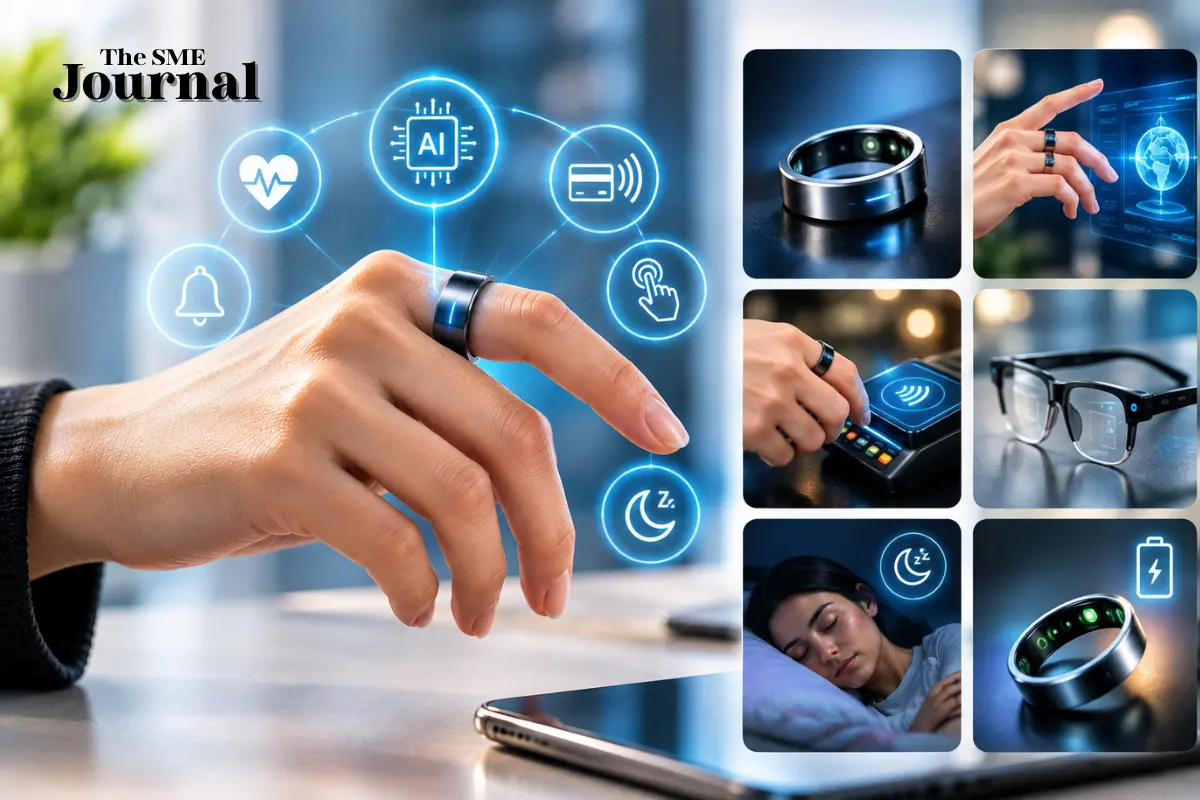
Smart rings have quietly become one of the most interesting parts of the wearable technology market. What started largely as a discreet way to monitor sleep, heart rate and daily activity is now expanding into something much bigger: a small computer worn on the finger.
Recent developments from companies such as Ultrahuman and Circular show how quickly the category is changing. New smart-ring concepts are exploring everything from AI interactions and gesture controls to contactless payments and preventive health monitoring.
For consumers, that could eventually mean a wearable that does more than tell them how well they slept. It could become a way to interact with other devices, control digital experiences and receive useful health signals without constantly reaching for a smartphone.
From Health Tracker to Personal Interface
The biggest shift is happening at the software level.
Ultrahuman, the Bengaluru-based wearable technology company, raised $70 million in September 2026, with participation from Qualcomm Ventures and other investors. The company says it wants to move its rings beyond conventional health and sleep tracking and turn them into devices capable of running software directly on the ring.
The idea is significant because smart rings have traditionally depended heavily on smartphones or cloud services to make sense of the information they collect.
Ultrahuman is exploring applications that could allow its rings to interact with AI, act as game controllers, function as a pointer or mouse, and potentially serve as a digital key. Some of these capabilities are expected to reach existing Ring Air and Ring Pro devices through software updates, according to TechCrunch.
That changes the role of the smart ring. Instead of simply measuring the user, the device could increasingly become a way for the user to control technology.
Smart Rings Could Become Controllers for Smart Glasses
Another emerging use is interaction with augmented-reality devices.
A recently uncovered Ultrahuman patent describes a system in which two smart rings could be tracked in three-dimensional space to recognize hand movements and gestures. The technology could allow users to interact with AR environments and control digital interfaces through movements of their hands.
If this concept reaches commercial products, the combination of smart rings and smart glasses could create a new type of hands-free interface.
Instead of touching a phone screen, users could potentially point, gesture or tap a ring to interact with information displayed through smart glasses.
It is still important to note that a patent describes technology a company is exploring, not necessarily a feature that will appear in a future product.
Preventing Problems, Not Just Measuring Them
Health monitoring is also becoming more sophisticated.
A September 2026 patent filing from Ultrahuman explores the possibility of detecting not only when someone has fallen, but also whether they may be at risk of falling. The proposed system looks at signals such as changes in walking patterns and gait that could provide an early warning before an actual fall occurs.
That represents an important change in wearable health technology.
Traditional fitness wearables often focus on reporting what has already happened — how many steps someone took, how long they slept or how high their heart rate was. Emerging systems are increasingly looking toward identifying patterns that could provide earlier warnings.
The technology is still under development, so it should not be treated as a proven medical or safety solution. But the direction of research shows where wearable technology could be heading.
Payments and Alerts Are Coming to the Ring
Smart rings are also gaining more everyday functions.
Circular's newly announced Ring 3 series includes an NFC chip designed for contactless payments, along with vibration-based alerts for alarms and reminders. The Ring 3 Pro also includes health-monitoring features such as ECG, blood-pressure trend tracking and sleep analysis.
The appeal is straightforward: a ring can perform certain tasks without needing a screen.
That screen-free approach could be one of the category's biggest advantages. Users can receive an alert or make a payment without pulling out a phone or looking down at a watch.
Why Companies Are Paying Attention
The growing interest in smart rings is also reflected in the business world.
Oura, one of the best-known names in the category, began the roadshow for its U.S. IPO in September 2026 at a targeted fully diluted valuation of about $15.62 billion. Reuters reported that the company and existing investors planned to raise as much as $2.2 billion through the offering.
Oura reported selling 3.6 million rings in the 12 months ending June 30, while revenue for the nine months ending June increased about 74% year over year to $1.21 billion, according to its IPO disclosures cited by Reuters.
Those numbers suggest that smart rings are becoming more than a niche accessory. They are developing into a broader consumer technology category with hardware, software and subscription opportunities.
What Comes Next for Smart Rings?
The next stage of wearable technology may not be about adding more screens. It could be about making technology less visible.
A ring can continuously collect information, respond to gestures and interact with other connected devices while remaining relatively unobtrusive. That makes it potentially useful as part of a larger ecosystem involving smartphones, smart glasses, cars, AI assistants and health platforms.
At the same time, the industry will have to address important questions around privacy, accuracy, security and battery life. The more personal information these devices collect and the more functions they control, the more important those issues become.
For now, smart rings are still best known for sleep and fitness tracking. But the latest developments suggest that their next chapter could be considerably more ambitious.
The wearable of the future may not be the device you look at.
It could be the one you barely notice you're wearing.
5 FAQs
1. What can smart rings do besides track fitness?
Smart rings are expanding into AI interaction, contactless payments, gesture controls, sleep monitoring, alerts and other connected-device functions.
2. Are smart rings becoming AI devices?
Yes. Companies are exploring ways for smart rings to interact with AI systems and serve as interfaces for other connected devices.
3. Can smart rings make payments?
Some newer smart rings are being developed with NFC technology that can support contactless payments.
4. Can smart rings detect health risks?
Emerging technologies are exploring features such as fall-risk assessment and other health signals. These capabilities are still developing and should not automatically be considered medical-grade.
5. Why are smart rings becoming more popular?
Their small, screen-free design allows users to collect health data and interact with technology without constantly wearing or looking at a smartwatch or smartphone.
The minimal-text article image has also been generated above, designed around smart rings, AI, health monitoring, payments and connected wearable technology.