
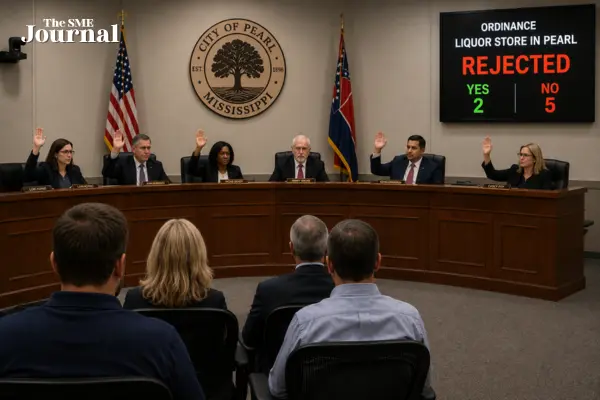
The Pearl liquor store ordinance rejected by city board on September 2, 2025, has drawn intense reactions across the Rankin County city. The 5-2 Board of Aldermen vote brought an end, at least for now, to Mayor Jake Windham's attempt to allow retail liquor stores in Pearl under a controlled system.
The ordinance would have allowed liquor stores with tight zoning controls, minimum distance from residential areas, and a requirement that businesses be in freestanding buildings. Supporters said this was not an open door to uncontrolled growth but a carefully controlled path to economic opportunity.
Mayor Windham upset with the outcome
Mayor Windham, a strong supporter of the measure, said the board's action could slow Pearl's momentum in attracting new business. Pearl currently allows beer sales seven days a week and liquor by the glass in restaurants but not retail liquor sales.
"I'd like us to continue to grow and continue to get better," Windham said after the vote. "This was just a tool in my tool chest so that we could move forward. I think it did slow us down a little bit."
Windham noted that many Pearl residents go outside the city to purchase liquor, taking both convenience and tax dollars to surrounding towns. If the Pearl liquor store ordinance rejected by city board had passed, he said, it would have kept money in the community while offering opportunities for small business owners.
Economic promise vs. community concerns
Supporters of the ordinance cited the success of other Mississippi cities that allow retail liquor stores with controls. They said sales tax dollars could have been spent in Pearl's infrastructure, schools, and civic programs.
But opponents were worried about unintended consequences. Several board members questioned whether liquor stores could harm Pearl's family-friendly image or have a negative effect on neighborhoods. That reluctance proved to be the deciding factor, as five aldermen voted down the proposal.
The 5-2 margin underscored the tension between Pearl's desire for economic growth and its conservative approach to social change.
The people's role in the debate
While disappointed, Mayor Windham said that community sentiment must ultimately guide city policy.
"At the end of the day, the voice of the people would be the ones that rang," he said. "It should be governed by the people and guided by the people. We do their bidding. And so, I just feel very strongly about that."
His words suggest the debate is far from over. Although the Pearl liquor store ordinance rejected by city board is now on the shelf, future discussions, public hearings, or even voter initiatives could bring it back to life.
What's next for Pearl?
For now, Pearl's alcohol policies remain unchanged: restaurants can serve liquor by the glass, and beer can be sold seven days a week. But residents seeking packaged liquor must still shop in surrounding communities.
The ruling leaves Pearl leaders with a dilemma: how to balance the city's reputation as a retail and family center with the pressure for economic growth. Pearl has been quietly growing as a destination in Rankin County, and whether retail liquor stores will ultimately fit into that vision is to be determined.
Some residents believe the city missed an opportunity to modernize and bring in tax dollars that could be used to improve roads and services. Others believe the cautious approach reflects community values and preserves Pearl's character.
A conservative approach to development
The board's ruling highlights the cautious philosophy that is guiding many city leaders. Growth, Mayor Windham said, must be sustainable and community-driven.
"We want to grow," Windham said, "but it's got to be growth that benefits our people."
Whether Pearl revisits the ordinance in the months ahead may depend on how loudly residents make their voices heard. Pearl liquor store ordinance rejected by city board has clearly become a flashpoint issue—one that combines economics, culture, and community identity in equal proportions.z
Q1. Why was the Pearl liquor store ordinance rejected?
The Board of Aldermen voted 5-2 against the proposal due to concerns about community impact and Pearl’s family-friendly image.
Q2. What did the ordinance propose?
It would have allowed retail liquor stores under strict zoning and location rules.
Q3. What was Mayor Jake Windham’s view on the decision?
Mayor Windham said the rejection could slow economic growth and business opportunities in Pearl.
Q4. Can Pearl restaurants still serve alcohol?
Yes, restaurants can serve liquor by the glass, and beer sales remain allowed seven days a week.
Q5. Could the liquor store proposal return in the future?
Yes, city leaders and residents may revisit the issue through future discussions or public initiatives.








.webp)